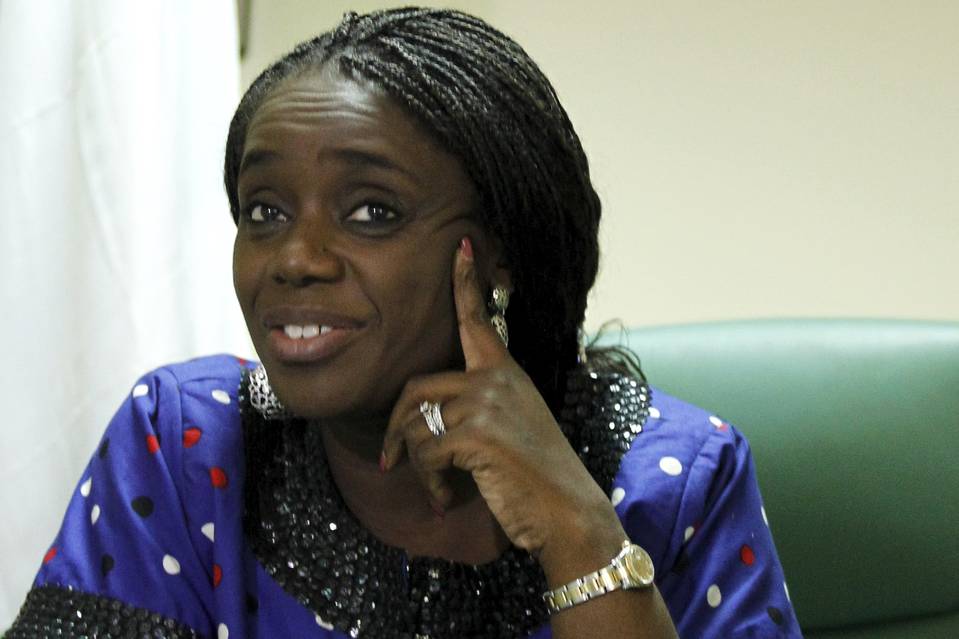
ABUJA, Federal Republic of Nigeria. Minister of Finance, Mrs. Kemi Adeosun, has refuted a report published by Financial Times on Sunday suggesting that Nigeria, has applied for emergency loans from World Bank and African Development Bank, AfDB. In a statement issued by her Special Adviser on Media Matters, Mr. Festus Akanbi, the minister emphatically said that Nigeria did not apply for any emergency loan.
Akanbi quoted the minister as saying: “The truth is that Nigeria, as part of the plans to fund the 2016 budget currently undergoing the approval process of the National Assembly, has indicated an intention to borrow N1.8trn principally for investment in capital projects to stimulate the economy.” She said the option of the World Bank was to ensure an optimum financing structure, noting that the 2016 budget is part of the Medium-term Economic Framework (MTEF) of the Federal Government, which the World Bank is aware of.
According to her, the proposed budget deficit will be funded equally through external and domestic sources. Adeosun, however, confirmed that Nigeria was exploring the options of multi-lateral agencies like the World Bank and AfDB and export credit agencies such as China Exim Bank due to their concessionary rates of interest.
She said the need to invest in infrastructure to stimulate the economy and the long-term pay back of capital project demand that lowest cost of fund be made, adding that “in that regard, we are discussing with multilateral agencies like the World Bank with concessionary loans and banks like China Exim Bank with concessionary rates. “Nigeria, as a member of World Bank group is entitled to access available funds like every member-country.
” Adeosun said no application for loans had been made to any of the multilateral agencies, saying that Nigeria is simply discussing options for funding 2016 budget. Giving further clarifications on the strategy being explored for foreign loans to fund the budget, she explained that the overall objective was to provide the lowest possible cost of funds to finance capital projects to stimulate the economy through in such areas as power, transport, road and housing sectors, among others.
In addition, she explained that the strategy of pursuing increased foreign borrowing was designed to ensure that the Federal Government does not “crowd out” the private sector in the domestic market. The minister, who harped on the need to invest in key infrastructure to stimulate the economy and the long-term payback period of capital projects, pointed out that the nature of the projects required that the lowest cost of funds be obtained.
She explained that since the loans and credit from the multilateral institutions and credit agencies would not totally close the deficit gap in the budget, the balance of foreign borrowing would be raised in the Eurobond market at commercial rates of interest. The minister explained that by blending these different sources of funding, the overall cost of funds will be maintained at the lowest possible level. “As far as possible, our foreign borrowing will be tied to specific capital projects.
A number of these projects are revenue generating, which will be used to fund the loan repayments,” she added. It would be recalled that as part of its Medium Term Expenditure Framework and Fiscal Strategy, the Federal Government had indicated its plan to stimulate the economy and achieve a real GDP growth rate of 4.2 per cent in 2017. The government also hinted of its plans to reduce cost of governance, extracts efficiencies in public service and enhancing revenue collections; increase government expenditure on infrastructure namely, Transport, Roads, Housing and Power.
Credit: National Mirror (Nigeria)